Japan-market model file
Toyota HiAce H100
The H100 is Toyota's fourth-generation HiAce van, on sale from 24 August 1989 until the fifth generation, the H200, went on sale on 23 August 2004. The table is the August 1989 Super Custom Limited rows. They are 1,690 mm wide. The photograph is a later long van, a 2.0 DX, not one of those three grades. Diesel output later in the run, and the H200's diesel output, are not in the tables used here.
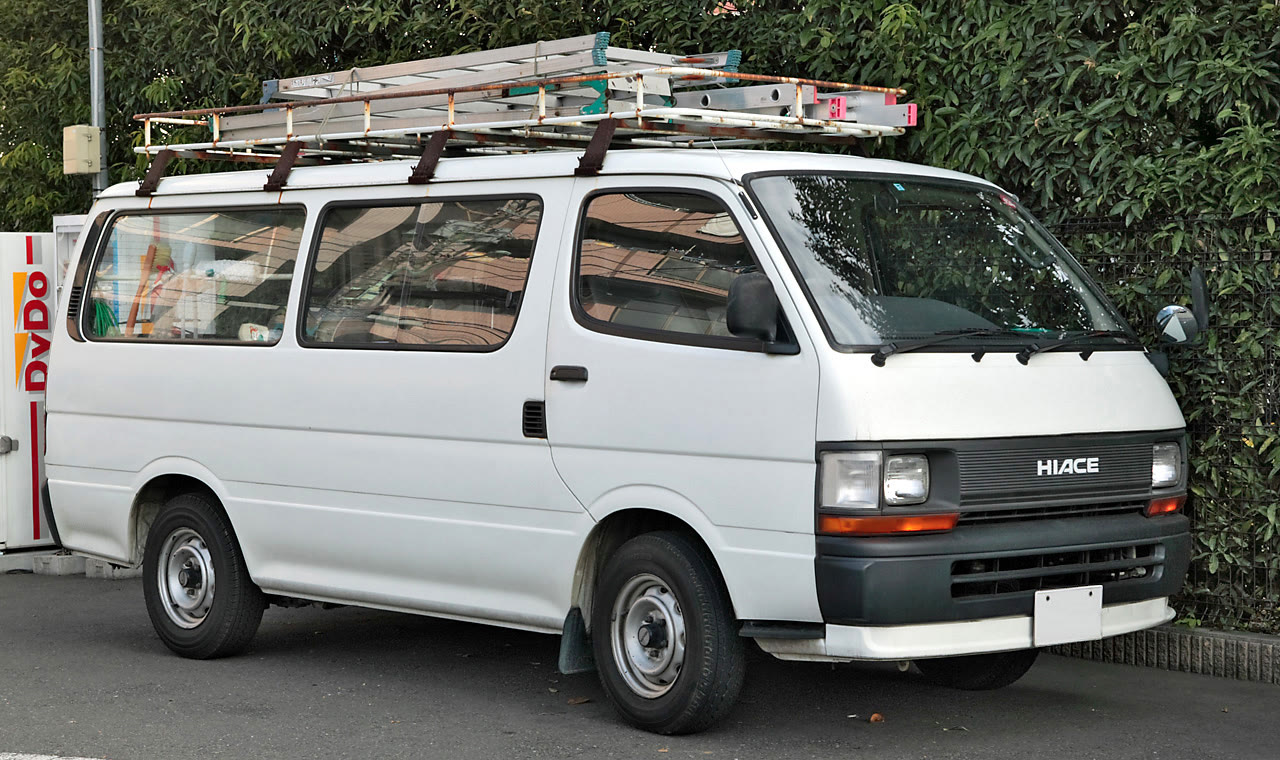
- Production
- August 1989–August 2004
- Codes
- RZH101G, RZH100G, LH100G, TRH214W
- Where it was sold
- Toyota's history page dates the fourth-generation HiAce van to 24 August 1989. The fifth generation went on sale on 23 August 2004, and Toyota calls that a full model change after 15 years. The dates below are that fourth generation. A van built after the change is an H200, with its own manufacture date. The HiAce truck is a different line and is not this van.
Import age
Computed from the production range on this page and the official age rules. The date that matters is the manufacture date of the individual vehicle. Checked November 9, 2026.
United States, 25 years
A vehicle built at the start of the run is past the 25-year mark for United States (August 2014). One built at the end reaches it in August 2029.
Canada, 15 years
Every manufacture date in the recorded run is past the 15-year mark for Canada. The earliest reaches it in August 2004, and the latest in August 2019.
Specifications
| Catalog row | August 1989 Super Custom Limited, three grades. The photograph is a 100-series long van, 2.0 DX, and is not one of these three grades. |
|---|---|
| Engine, 2.4 petrol | 2RZ-E, water-cooled inline-four, OHC. 2,438 cc. 120 PS at 4,800 rpm, net. Type E-RZH101G-MFPQE. Weight 1,810 kg. |
| Engine, 2.0 petrol | 1RZ-E, water-cooled inline-four, OHC. 1,998 cc. 110 PS at 5,200 rpm, net. Type E-RZH100G-MFPQE. Weight 1,810 kg. The photographed van is described as a 2.0 DX, which is not this Super Custom Limited grade. |
| Engine, 2.4 diesel | 2L-T, water-cooled inline-four, OHC, turbo. 2,446 cc. 94 PS at 4,000 rpm, net. Type Q-LH100G-MFPQX. Weight 1,900 kg. Torque is not in the table. |
| Body | All three August 1989 grades: 4,615 x 1,690 x 1,980 mm. Wheelbase 2,330 mm. A long or super-long body is a different size and is not given a row here. |
| Drivetrain | The history text says four-wheel-drive vans at this launch used only the 2.8-litre 3L diesel. That engine is not one of the three table rows. In August 1993 the four-wheel-drive system changed from a part-time transfer to a full-time system without a center-differential lock or a sub-transmission. |
| Fifth generation, August 2004 | H200. The three petrol rows on Toyota's launch table use the 2TR-FE, 2,693 cc, 151 PS at 4,800 rpm. One long two-wheel-drive row is 4,840 x 1,880 x 2,105 mm, wheelbase 2,570 mm, 1,910 kg, type CBA-TRH214W-JDPDK. Super-long rows are larger. Diesel codes are listed, including KDH222B, and no diesel output is printed. |
Model codes
- RZH101G. August 1989 Super Custom Limited with the 2RZ-E, type E-RZH101G-MFPQE on the history table.
- RZH100G. August 1989 Super Custom Limited with the 1RZ-E.
- LH100G. August 1989 Super Custom Limited with the 2L-T diesel. The history page also lists RZH110G, LH110G, and LH107G as types of this generation. Those rows were not opened.
- TRH214W. A fifth-generation, H200, code on the 23 August 2004 table. Not an H100. Listed so a later van is not ordered as this one.
Japan specification
- The August 1989 table is 1,690 mm wide. Later wide bodies, high roofs, and the 1KZ diesel that importers often mean by a late H100 are not in this table, so their power, weight, and tire size are not listed.
- The fifth generation is a different van. Its US 25-year date runs from a manufacture date on or after 23 August 2004, not from 1989. The dates at the top of this page stop at the August 2004 change.
- In May 1992 Toyota offered the HiMedic, a high-standard ambulance based on the HiAce with the V8 used in the Celsior. Its dimensions and output are not in the van table and are not listed.
Common issues
Nothing is recorded here yet.
Maintenance
- No oil grade, tire size, or service interval is in the August 1989 table. A 2L-T part is not a later diesel, and it is not a 2TR-FE or KDH part from the 2004 van.
Parts and tools for this model
As an Amazon Associate, Galapagos Japan earns from qualifying purchases. These are sizes and part numbers for this model. Check the listing against your own vehicle before you buy.
Finding parts in Japanese
- ハイエース
- ハイエース 100
- LH100
- RZH100
- 2L-T
- KDH
- ハイエース パーツ
- Search the code on the plate. LH100 and RZH100 are fourth-generation codes from the 1989 table. TRH and KDH codes are the 2004 van. A HiAce truck is not this van.
On this site
No articles are linked yet.